
General Contractor Cost Guide: What Morgan Hill Homeowners Pay in 2026
General contractor costs in Morgan Hill run 20 to 35 percent above national remodeling averages in 2026. A mid-grade kitchen remodel that national calculators quote at $45,000 to $60,000 is landing at $70,000 to $95,000 here. The gap comes down to Santa Clara County labor rates, permit fees, and hillside site conditions that most online estimators never factor in.
If you’re pricing a remodel, addition, or ADU in Morgan Hill and want a real number, call (833) 725-3508 for a free estimate. Otherwise, here’s what we’re seeing on actual bids this year.
How Much Do Common Morgan Hill Remodel Projects Cost in 2026?
Before we get into the why, here are the ranges we’re quoting on real Morgan Hill jobs right now. These are total project costs, including materials, labor, permits, and general contractor markup.
- Kitchen remodel: $70,000 to $140,000 for a mid-grade renovation of a 150 to 200 square foot kitchen. Budget-level cabinet and counter swaps can land around $45,000. High-end kitchens with custom cabinetry, Cambria or Caesarstone counters, and structural changes run $150,000 to $250,000.
- Bathroom remodel: $35,000 to $65,000 for a full gut and rebuild of a standard 40 to 60 square foot bathroom. Primary baths with Toto or Kohler fixtures and tile work run $55,000 to $95,000. A quick cosmetic refresh can stay under $25,000.
- ADU construction: $250,000 to $450,000 for a detached 600 to 1,000 square foot unit. Prefab systems from Boxabl, Plant Prefab, and Abodu typically land on the lower half of that range when site work is straightforward.
- Whole-home renovation: $180 to $320 per square foot depending on scope. A full interior gut of a 1,800 square foot Morgan Hill home usually sits between $325,000 and $575,000.
- Room addition: $300 to $450 per square foot for stick-built additions of 300 to 800 square feet. Expect the permitting and foundation work to add $15,000 to $40,000 before framing even starts.
These numbers assume a property with reasonable access. If you’re up in the hills off Hale Avenue or Coyote Creek, add 10 to 15 percent for site logistics. Steep driveways, retaining wall considerations, and limited staging areas all cost money.
Why Morgan Hill Bids Run Higher Than National Estimates
Most online cost calculators use blended national labor rates. They don’t account for three things that hit every Morgan Hill bid.
Prevailing wage pressure on skilled trades. The Bay Area labor market for carpenters, electricians, and plumbers is tight and expensive. Journey-level carpenters in Santa Clara County earn 40 to 60 percent more than their counterparts in Sacramento or the Central Valley. That labor cost flows straight into your bid.
Santa Clara County permit and impact fees. Morgan Hill is its own permitting jurisdiction, but the city’s fee schedule reflects county-level realities. A kitchen remodel with any structural work can run $3,000 to $7,000 in permit costs alone. A room addition or ADU will trigger school impact fees and park fees that add $10,000 to $25,000 before a single trade sets foot on site.
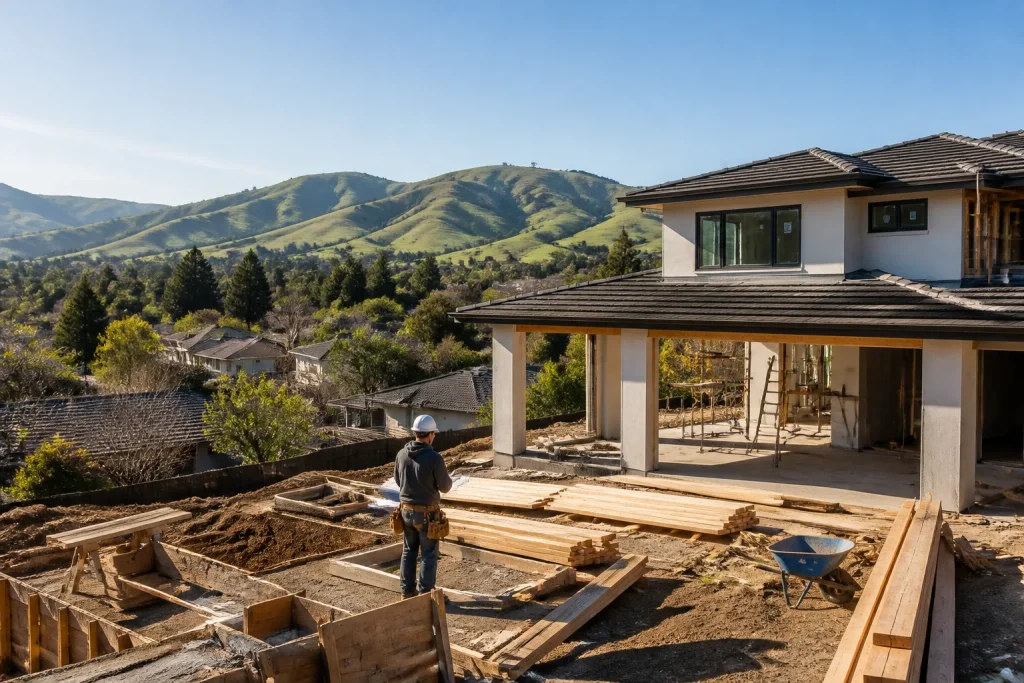
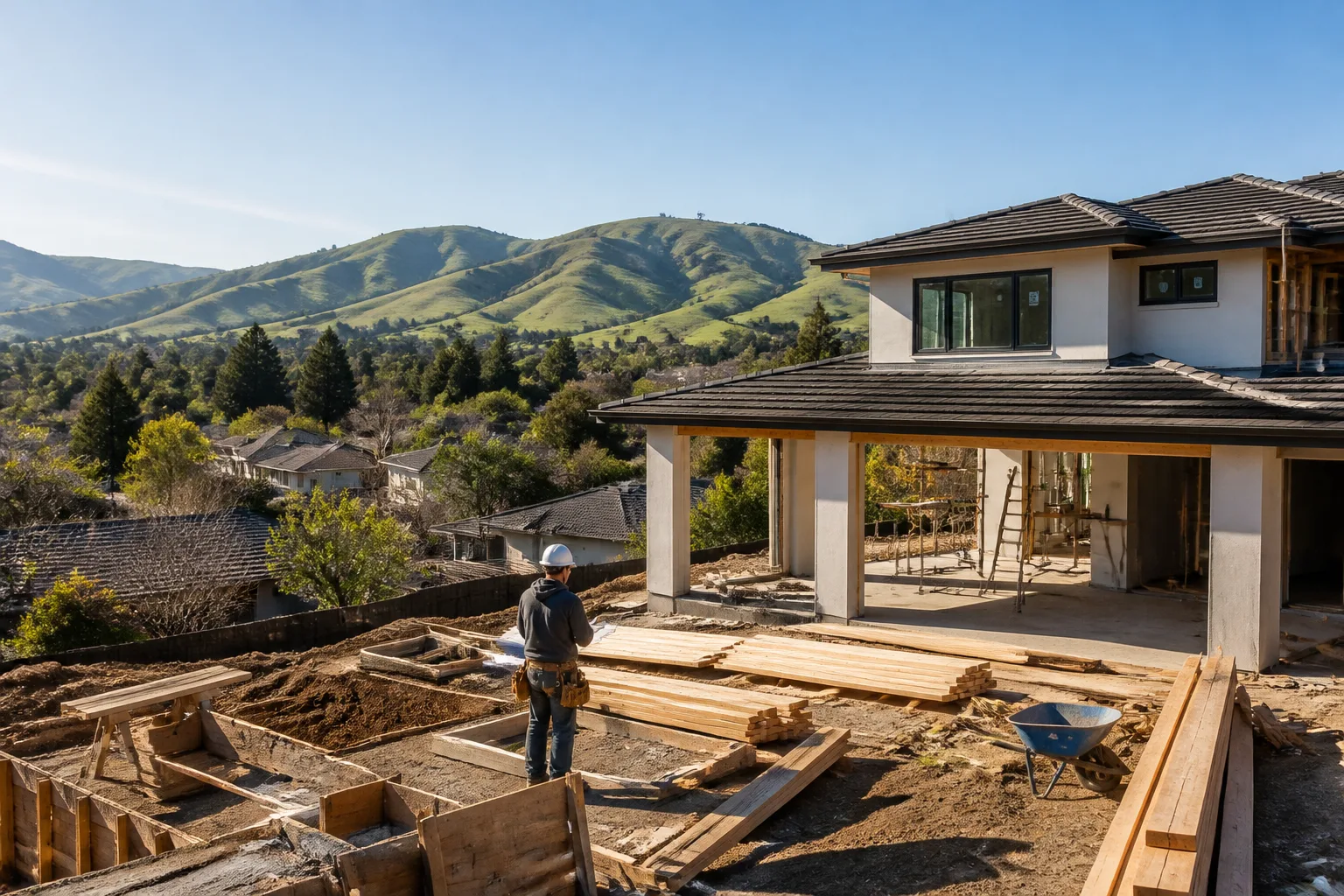
Hillside site access and soils. Morgan Hill’s eastern edges climb into the Diablo Range. Sloped lots mean retaining walls, pier or caisson foundations instead of flat slab work, and sometimes crane time for material delivery. Flat-lot national estimates simply don’t apply. We quoted a bathroom addition on a hillside parcel near Jackson Oaks last month where the site work outpaced the interior finish costs by a wide margin. That’s normal here.
If you want to understand how these factors apply to your specific lot, home remodeling costs follow the same logic across South Bay markets, and Morgan Hill’s hillside parcels add their own twist.
How General Contractor Markup Actually Works
Every general contractor applies a markup to trade subcontractor bids. In Morgan Hill that markup typically runs 15 to 25 percent. It covers project management, scheduling, site supervision, warranty administration, and the risk that something goes wrong and the GC eats the cost.
Here’s what most homeowners miss: a lower markup does not automatically mean a cheaper or better job. If two GCs are bidding the same kitchen remodel and one shows a 10 percent markup while the other shows 20 percent, the real question is what’s underneath those numbers.
We’ve seen bids where the “low markup” contractor padded the sub bids by 10 to 15 percent before applying their fee. The homeowner saw a lower percentage and assumed honesty. The final number was actually higher than the transparent 20 percent markup bid. The lesson: compare total cost and line-item detail, not the markup percentage in isolation.
Ask every bidder the same question: “Can you show me the actual sub bids you’re marking up?” A contractor who refuses is hiding margin structure. A contractor who shares them is operating transparently. That transparency matters more than the percentage.
This is the same coordination advantage we bring across general contractor work throughout the South Bay. One license, one point of contact, and line items you can actually read.
What Value Engineering Actually Means (And Where You Can Actually Save)
“Value engineering” gets thrown around a lot. In practice, it means swapping materials or methods to cut cost without cutting structural integrity or usable lifespan. Here are the swaps that actually work on Morgan Hill projects.
Countertop tier flexibility. Cambria and Caesarstone are excellent products, but Silestone offers comparable durability at 15 to 20 percent lower cost for many colors. If the premium brand isn’t driving your decision emotionally, this swap saves real money.
Cabinet line adjustments. KraftMaid and Wellborn both make strong mid-grade cabinets. Choosing a simpler door profile and finish within the same manufacturer’s line can trim $5,000 to $10,000 on a full kitchen without touching the structural quality of the boxes.
Window and door matching. We carry access to PGT, CGI, Therma-Tru, ViewLux, and ECO Window Systems. That range lets us match a window spec to the actual exposure and climate demand of the house. You don’t need hurricane-rated glass on a shaded north-facing wall in Morgan Hill. You might on a west-facing wall that takes full afternoon sun. Matching the product to the project, not the catalog, is where savings live.
Exterior cladding choices. James Hardie siding is a premium product for good reason, but there are sections of a home where a simpler lap profile or a different texture grade performs identically for less. We’ll tell you where the upgrade matters and where it doesn’t.
Value engineering done right keeps the structure solid, the waterproofing intact, and the fixtures functional while trimming finish-level spend. Done wrong, it strips out the waterproofing membrane and the shear paneling. That’s the difference between a contractor who understands construction and one who’s just cutting numbers to win a bid.
And one more thing: if you’re planning an ADU, the prefab route through manufacturers like Boxabl or Plant Prefab can drop your build time and site disruption significantly. Not every lot suits prefab, but when it works, the cost and schedule benefits are real. We’re one of the few GCs in the area with direct experience installing these systems.
How to Compare Two Bids for the Same Scope
Two contractors can both quote $180,000 for a whole-home renovation and be bidding completely different projects. Here’s how to tell them apart.
Ask for the spec sheet. Every bid should include a written scope of work with specific materials named. “New kitchen cabinets” is not a spec. “KraftMaid Vantage line, shaker profile, maple boxes, soft-close hardware, 32 linear feet” is a spec. If the bid doesn’t name brands and quantities, it’s a placeholder, not a price.
Ask what’s excluded. Permits, dumpsters, debris hauling, and finish materials are the classic exclusion categories. A lower bid that excludes $8,000 in permits and $3,000 in hauling isn’t lower. It’s a surprise bill waiting to happen.
Ask about change order policy. Change orders happen on every remodel. The question is how they’re priced. A contractor who prices change orders at cost plus a defined and written percentage is predictable. One who prices them “as needed” is not. Get the change order markup in writing before you sign.
Compare the sub list. Ask which electrical, plumbing, and tile contractors each GC uses. The quality of the subs determines the quality of the finished work. A GC with an established sub roster and a working relationship built over years will deliver different results than a GC cold-calling subs off a list.
If you’re evaluating bids for a home renovation across the South Bay, the same comparison framework applies. What changes is the local permit fees and site conditions.
The Bottom Line
Morgan Hill remodeling costs in 2026 are running higher than national averages, but the range is predictable once you understand the local drivers. Labor is expensive here because it’s skilled and in demand. Permits cost real money. Hillside sites add logistics complexity. And general contractor markup, when it’s transparent, is the cost of having one accountable party manage the whole thing.
The smartest move you can make is to get a written, line-itemed bid with specific brands and a defined scope. Compare total price and exclusions, not markup percentages. And ask the hard questions about spec sheets, sub lists, and change order policies before you sign anything.
If you’re in Morgan Hill and want a straight answer on what your project should cost, we offer free estimates with no pressure. Call (833) 725-3508 and we’ll walk your property, talk through your options, and give you a written number you can actually plan around. Whether you’re redoing a kitchen, adding an ADU, or renovating the whole house, one contractor can handle every phase from foundation to finish.
Frequently Asked Questions
Most Morgan Hill general contractors bill between $85 and $150 per hour for project management time, but most residential work is bid as a fixed project total rather than hourly. Time-and-materials contracts are rare for remodels because they shift risk to the homeowner. If a contractor proposes hourly billing for a full remodel, ask for a firm not-to-exceed cap in writing. For a fixed-price bid that covers the full scope, call (833) 725-3508 for a free estimate.
Finish materials. Countertops, cabinet door profiles, fixture brands, and lighting are the line items where you can trim 10 to 20 percent without touching structural quality or waterproofing. The places you should never cut: foundation work, shear wall requirements, roofing membrane, and electrical panel capacity. Those trades are expensive to fix when they fail, and in Morgan Hill’s climate, failures happen at the worst possible time. Call (833) 725-3508 and we’ll show you exactly where the savings are and where they aren’t.
Yes. A kitchen remodel with structural work typically runs $3,000 to $7,000 in city permit fees. A room addition or ADU can trigger $10,000 to $25,000 in permits and impact fees before construction starts. Any contractor who says permits aren’t necessary is cutting a corner that will come back on you at resale and with your insurance company. We pull permits and pass through the actual fee cost, no markup on city fees.
A mid-grade kitchen remodel typically runs 6 to 10 weeks from demolition to final inspection. Bathrooms run 3 to 5 weeks. A whole-home renovation can take 4 to 8 months depending on scope and inspection scheduling with Morgan Hill’s building department. The schedule gets longer if structural work is involved or if you’re changing the footprint. We set realistic timelines up front and update you weekly, because surprises on schedule are as bad as surprises on budget.
Written by the team at Brookside Contractors, serving Morgan Hill since 2011.
Need Construction Help?
Call Brookside Contractors — licensed & insured, here with fast after-hours help in Morgan Hill.
(833) 725-3508