
Last updated October 30, 2026
 Home additions & ADU
 Kitchen remodeling
 Bathroom remodeling
 Roofing
 Windows & doors
 Driveway & pavers
 Fence
Free written scope consultation - allowances, timeline, and change-order rules on paper before a single trade is scheduled
Construction Emergency Preparedness Guide for Morgan Hill Homes
Most homeowners in Morgan Hill assume a construction emergency means a pipe bursting at 2 a.m. or a tree limb through the roof during a winter storm. Those are emergencies, sure, but they’re the ones you can see coming. The ones that cost real money start quietly: a hairline crack in the foundation on the west slope near El Toro, a roof valley that’s been shedding granules since the last big rain, a deck ledger pulling away from the house on a hillside lot off Cochrane. This guide covers what a construction emergency actually looks like in Morgan Hill, how to assess the damage before it gets worse, what you can safely handle yourself versus when to read our DIY vs Professional Construction: The Morgan Hill Homeowner’s Decision Guide, and when the right call is a licensed general contractor who can manage the entire fix under one roof, from structural shoring to finished surfaces. By the end, you’ll have a working plan for the emergencies that matter most in this climate and this housing stock.
Styles & brands we work with
Quick Answer
A construction emergency in a Morgan Hill home is any structural, water-related, or code-driven failure that will get more expensive the longer you wait to address it. This includes foundation movement, roof and flashing failures, water intrusion at windows and doors, sewer line breaks, and failed retaining walls, all of which are common in Morgan Hill due to clay-rich soils, seasonal rains, and homes built across multiple decades with aging materials. The smartest preparedness move isn’t a stack of tarps and a generator, it’s knowing which failures demand immediate professional intervention and which ones you can document, contain, and schedule for a proper repair.
Table of Contents
- Why Morgan Hill Homes Fail Differently
- Build Your Pre-Emergency File Before You Need It
- Classifying the Emergency: Red, Yellow, and Monitor-Only Conditions
- Water Intrusion: The Most Common Morgan Hill Emergency You’ll Face
- Foundation and Soil Movement: What Clay Soil Does to a House
- Roof and Flashing Failures: Reading the Warning Signs
- Sewer and Drain Failures: The Underground Emergency
- Retaining Walls and Slope Stability on Hillside Lots
- Common Mistakes to Avoid
- When to Call a Professional
- Frequently Asked Questions
- The Bottom Line
Why Morgan Hill Homes Fail Differently
Morgan Hill sits on a unique blend of geology and microclimate, and both shape how homes here break. The western foothills catch more rain than the valley floor. The valley itself sits on expansive clay soils that swell and shrink with seasonal moisture, a slow-motion force that works against slabs and stem walls year after year. Homes built in the 1960s and 1970s, common in older pockets of Morgan Hill, were not engineered for the soil movement we now understand well. Homes built in the 2000s fare better structurally, but many have stucco assemblies and window flashings that begin to fail at the 15-to-20-year mark. We’ve walked properties near Nordstrom Elementary where a 40-year-old retaining wall has shifted four inches in a decade, and properties off Tennant Avenue where a stucco crack that looked cosmetic traced back to a beam that was never properly tied to the foundation. The point is this: in Morgan Hill, the house tells you what’s wrong if you know how to read it. Most people don’t, and that’s why small problems become construction emergencies.
Build Your Pre-Emergency File Before You Need It
The single most useful thing you can do for your Morgan Hill home costs nothing and takes one afternoon. You build a pre-emergency file. When something fails, you don’t want to be digging through a drawer for a warranty card or trying to remember which contractor did the last roof repair. You want a folder, physical or digital, that contains the essential facts about your home’s construction and its repair history. Here’s what goes in it:
- As-built drawings or original blueprints, if you have them or can get them from the City of Morgan Hill’s building department. These tell any contractor exactly how your home was framed, where load-bearing walls sit, and what foundation type you have.
- Permit records for every major renovation, including roofing, electrical panel upgrades, water heater replacements, and any structural work. The Morgan Hill building division keeps these on file, but you want copies in your own hands.
- Warranty documentation for the roof, windows, siding, and any appliance or system with a long-term warranty. Note the install date and the contractor’s name on each document.
- A moisture intrusion log if you’ve ever seen water inside your home. Note the date, the weather conditions, the location of the water, and what was done about it. This log is gold when a professional is trying to trace a leak’s source.
- Photos of your home’s exterior and interior at baseline, meaning when everything looks fine. Having a “before” reference helps you spot slow changes in drywall cracks, exterior siding, or roofline sag that you might otherwise miss.
- Your insurance policy’s declarations page, plus the claim phone number, stored somewhere accessible from a phone or a neighbor’s house, not just a file cabinet inside the home that might be affected by the emergency.
This file turns a chaotic emergency into a manageable process. When you call a contractor, you can describe the problem with specificity, send photos, and make decisions faster. That speed matters in Morgan Hill, where the window between a small water intrusion and a major interior repair can be measured in days, not weeks.
Classifying the Emergency: Red, Yellow, and Monitor-Only Conditions
Not everything that looks bad is an emergency, and not everything that looks minor can wait. In our experience running general contractor services across Morgan Hill and Los Gatos, homeowners consistently misclassify problems in both directions. They panic over a cosmetic crack in a patio slab while ignoring the actual red flag: a window that suddenly requires a hard slam to close, which often means the opening around it has shifted. A simple classification system keeps your response proportional to the risk.
Red Conditions: Act Within 24 Hours
These are the emergencies that actively damage your home or create unsafe conditions. Water running inside the house from any source, a roof leak that has penetrated the decking and is dripping into living space, a gas odor that persists, a foundation wall that has visibly shifted or bowed in the last day, or any structural member that has cracked with an audible sound are all red conditions. Shut off water or gas at the main if you can safely do so, contain the immediate spread with tarps and buckets, and call a professional. Document everything with photos and notes while you wait.
Yellow Conditions: Schedule Within Two Weeks
Yellow conditions are problems that are getting worse but aren’t actively destroying the home today. A roof valley that has lost granules and is showing bare underlayment, a window that leaks only during driving rain from a specific direction, a retaining wall with a new crack that hasn’t yet shifted, or a foundation crack that has grown slowly over months are all yellow. These need a professional assessment soon, and the fix is usually far less expensive when addressed at this stage than when they escalate to red. Schedule the inspection, get a written scope and line-item quote, and knock it out.
Monitor-Only Conditions: Document and Watch
Some things are normal for Morgan Hill’s soil and building stock. Hairline cracks in stucco that appear and close seasonally as the clay soil expands and contracts are often cosmetic. A slab crack that hasn’t changed width in three years is stable. A door that sticks slightly in winter but swings freely in summer is a humidity response, not a structural failure. The key discipline with monitor-only items is documentation. Take a photo with a measuring tape or coin for scale, date it, and check it every six months. If it changes, it moves to yellow. If it doesn’t, you’ve saved yourself thousands of dollars in unnecessary exploratory work.
Water Intrusion: The Most Common Morgan Hill Emergency You’ll Face
Water is the enemy that never stops working. Morgan Hill’s wet season, typically November through March, delivers concentrated rain onto homes that spend the rest of the year baking dry and hot. That cycle is brutal on building materials. Caulk dries and cracks. Flashing loosens. Stucco develops micro-fissures. And then the rain comes, and water finds every one of those openings. Water intrusion at windows and doors is the most common emergency we see across home remodeling projects in the Morgan Hill and Los Gatos area, and it’s one of the most preventable.
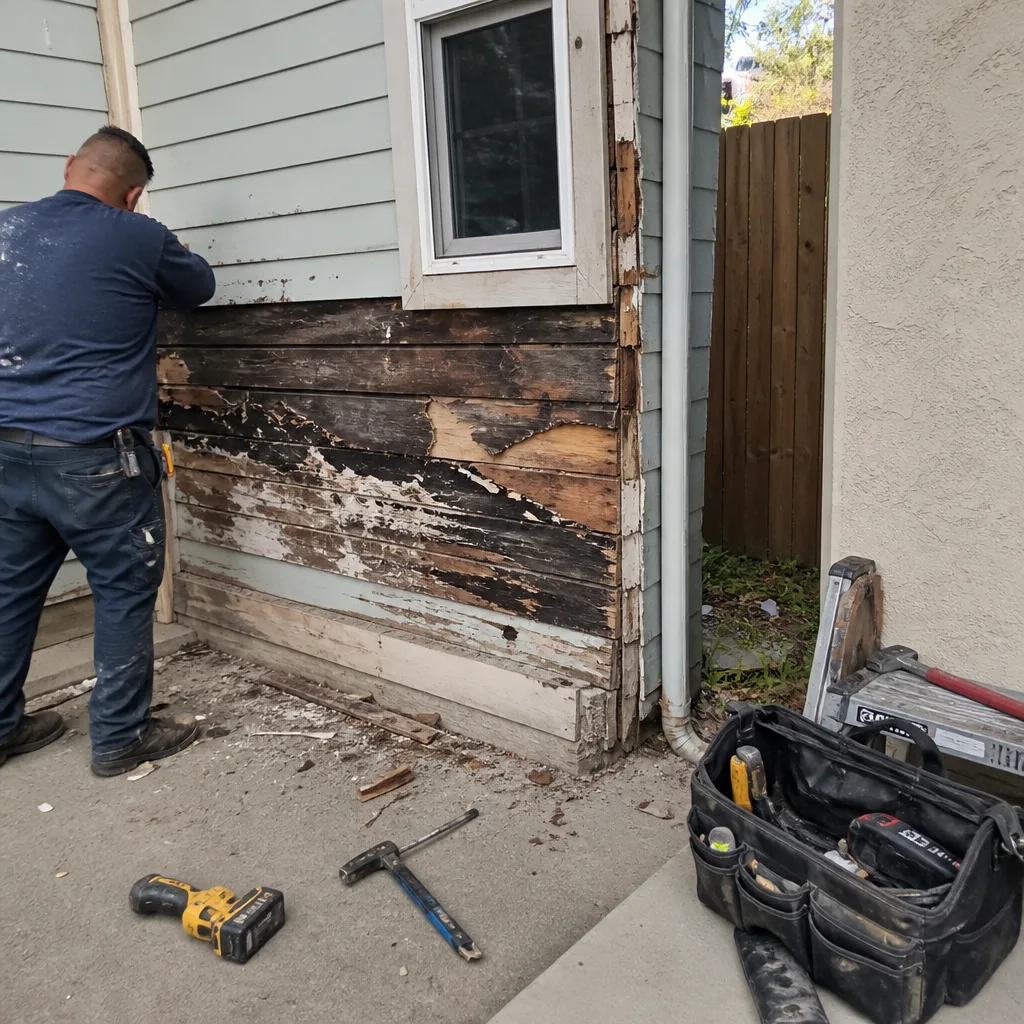
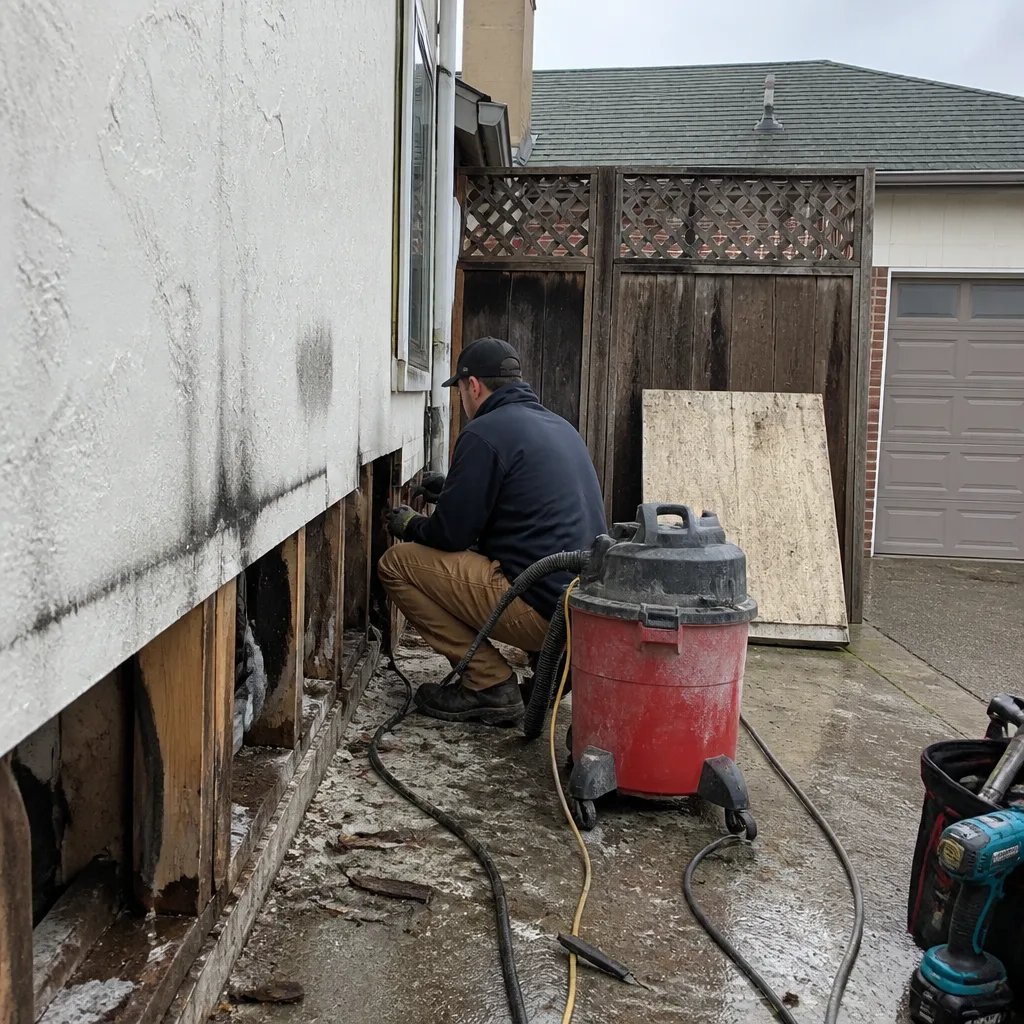
The first sign of water intrusion is usually a stain on the drywall around a window, or peeling paint on an interior sill, or a musty smell that doesn’t go away. By the time you see those signs, the water has already been working on the wall cavity. The fix involves more than caulk. A proper repair means removing the interior drywall in the affected area, assessing the framing for rot and mold, replacing damaged wood, addressing the source of the intrusion at the exterior, and then re-installing the window or door with proper flashing detail. That’s a multi-trade job, which is exactly the scenario where a single-contractor approach pays off. One team opens the wall, fixes the framing, re-flashes the opening, and closes it back up with finished surfaces. No coordination gaps, no finger-pointing between a window company and a drywall guy.
For homeowners looking at this repair, the cost conversation usually starts with the extent of hidden damage. Water travels laterally in a wall cavity, and what looks like a small stain at the corner of a window often traces back to a failed head flashing above the window, not the window itself. A good contractor opens a small section first, assesses the true scope, and then gives you a real number before proceeding with full demolition. If a contractor quotes you a full wall rebuild without opening anything up, that’s a red flag. If another quotes you a surface patch without opening anything, that’s a bigger red flag. The honest answer is: we need to look inside before we know.
Foundation and Soil Movement: What Clay Soil Does to a House
Morgan Hill’s expansive clay soil is the quiet force behind many of the construction emergencies that look like something else. A door that suddenly won’t latch. A window that binds. A drywall crack that appears overnight at the corner of a room. A tile floor that develops a crack running in a straight line from one wall to another. Homeowners often attribute these to settling, which is both true and misleading. What’s actually happening is that the soil under the foundation is shrinking during dry months and swelling during wet months, and the differential movement puts stress on the structure at specific points.
The most important diagnostic question is whether the movement is uniform or differential. Uniform settlement is when a foundation sinks slightly across its entire footprint, which rarely causes structural problems. Differential movement is when one part of the foundation moves more than another, and that’s what cracks walls, binds doors, and stresses framing connections. In Morgan Hill, the western foothills see more differential movement than the valley floor because the soil composition changes quickly across short distances on sloped lots. A home off East Dunne Avenue may have one corner sitting on nearly solid rock while another sits on several feet of expansive clay, and the house will respond to that difference for its entire life.
The emergency threshold is movement that’s suddenly visible. If a crack appears and grows a quarter-inch in a month, that’s a red condition. If a door that was fine in August won’t close in February, that’s a yellow condition worth investigating. The professional response usually starts with measuring the foundation’s flatness with a laser, mapping existing cracks with crack monitors, and checking the soil moisture around the perimeter. From there, the fix may range from something simple like correcting drainage that’s saturating one corner of the foundation, to something more involved like underpinning or installing helical piers. Here’s what the step-by-step assessment process looks like:
- Document the visible symptoms. Photograph every crack with a tape measure in frame. Note which doors and windows bind, and under what conditions.
- Check drainage around the foundation. Look for downspouts that empty at the foundation, soil that slopes toward the house, or irrigation spray that hits the foundation wall. These are the most common causes of differential movement in Morgan Hill, and they’re often the cheapest fix.
- Install crack monitors if the movement is slow enough to monitor safely. These simple gauges tell you precisely how much movement is happening over time.
- Call for a foundation assessment if movement is rapid, if cracks exceed about a quarter-inch in width, or if doors and windows begin sticking in ways they never have before.
- Address the drainage issue first in most cases. If the soil moisture is stabilized, the foundation often stabilizes with it.
One thing to know: foundation repair is rarely a DIY project, and it’s never one to defer. When a foundation is moving enough to crack walls and bind doors, the forces involved are measured in tons. That’s a job for an engineer’s assessment and a contractor with structural experience, not a handyman with a tube of epoxy.
Roof and Flashing Failures: Reading the Warning Signs
Roofs in Morgan Hill face a specific set of stressors. The summer sun bakes roofing materials at temperatures that accelerate granule loss on asphalt shingles. The winter rains then test every seam, valley, and penetration on that sun-damaged roof. Most roof failures don’t happen because the shingle was bad. They happen because the flashing detail where the roof meets a wall, a chimney, a skylight, or a valley was never done correctly, or has aged past its service life.
The warning signs are usually visible from the ground if you know what to look at. Dark stains spreading across sections of the roof often indicate granule loss and exposed asphalt. Curling or lifting shingle edges indicate the shingles have lost flexibility and will begin to crack. Missing granules in your gutters mean the roof is shedding its protective layer. Stains on the interior ceiling that appear during or after rain, especially in rooms below roof valleys and around chimneys, mean water is getting past the roofing layer. A sag in the roofline is always a red condition, because it means the decking underneath has been wet long enough to lose its structural integrity.
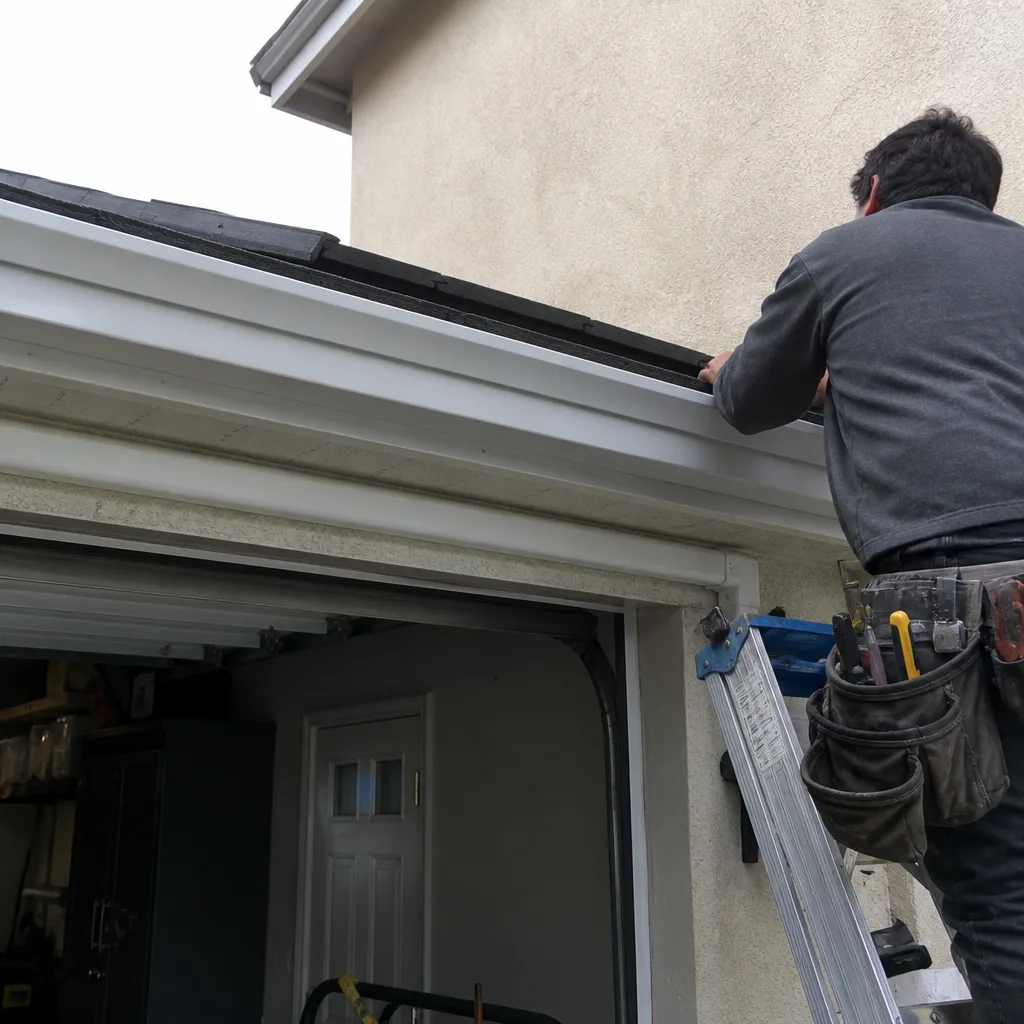
When a roof failure crosses the line into an emergency, the immediate priority is containment. Tarping a damaged section can prevent interior damage while you arrange for a proper repair or replacement. But tarps are a temporary solution, not a repair, and Morgan Hill’s winter winds will find weak points in any tarp. The permanent fix requires opening the affected area, replacing damaged decking, repairing or replacing the flashing details, and re-installing the roofing material to manufacturer spec. That’s a job for a contractor with roofing experience, and it’s one where material choice matters. Good roofing manufacturers like GAF and Owens Corning back their products with warranties that depend on correct installation. Match the material to the project’s exposure and pitch, and you get a roof that lasts. Guess wrong, and you’re doing it again in ten years.
Sewer and Drain Failures: The Underground Emergency
Sewer line failures in Morgan Hill don’t announce themselves with drama. They start with a slow drain in a bathroom that used to work fine, then a gurgle from a different fixture, then a smell. By the time sewage backs up into a tub or a floor drain, the line has been compromised for a while, and the repair has grown from a simple root removal to a full line replacement. The difference in cost between those two scenarios is the difference between a $500 service call and a $15,000 excavation.
The causes are specific to the region. Mature trees common in Morgan Hill neighborhoods, especially oaks, willows, and the larger ornamental landscape trees, send roots into any sewer line joint that has even a minor gap. Homes built before the mid-1970s often have clay or cast-iron sewer lines, and both materials crack with age and soil movement. Homes built on the west side, where soil sits against the hills, see additional strain from soil creep against buried lines. The lesson: don’t ignore slow drains. The cost curve on sewer problems is steep, and it gets steeper by the month.
The diagnostic step is a camera inspection, which is inexpensive relative to the cost of a failed line. A technician runs a camera down the line, marks the problem’s location, and gives you a clear picture of what’s wrong and where. From there, the options range from hydro-jetting for root intrusion that hasn’t yet cracked the pipe, to trenchless relining for moderate damage, to full excavation and replacement for collapsed lines. The trenchless options are a genuine advance, but they’re not right for every situation, and a contractor who recommends a lining without a camera inspection is guessing. Get the camera first.
Retaining Walls and Slope Stability on Hillside Lots
Morgan Hill’s hillside neighborhoods, particularly on the western slope and in the newer developments that step up the foothills, lean on retaining walls more than most people realize. A retaining wall isn’t just a landscaping feature on a sloped lot. It’s a structural element holding back tons of soil, and when it fails, the failure can take out a patio, a stairway, a portion of your yard, or in the worst cases, the stability of the ground under your home’s foundation.
The warning signs are specific. A retaining wall that has begun to lean or bow outward is losing its battle with the soil behind it. Horizontal cracks running along the wall face are serious, because they indicate the wall is bending under load. Water staining or efflorescence on the wall face means water is getting behind the wall and building up hydrostatic pressure, which is the number one cause of retaining wall failure. A crack between the wall and an adjacent walkway or stair means the entire assembly is moving. Any one of these signs is a yellow condition. Two or more together may be a red one.
The fix depends on the wall’s construction, its height, and what’s behind it. Low walls under three feet tall are often rebuilt as segmented block walls with proper drainage aggregate and weep holes. Taller walls, and any wall supporting a structure or located near a home, usually need an engineer’s design and a permit. The common thread in every successful retaining wall repair is drainage. If the wall is rebuilt without addressing the water that caused the original failure, you’re buying the same failure twice. A proper rebuild includes drainage aggregate behind the wall, a perforated drain pipe at the base, weep holes at intervals, and a grading plan that moves surface water away from the wall entirely. Morgan Hill’s rainy season will test the fix within months, and drainage is the difference between a wall that lasts forty years and one that leans again in five.
Common Mistakes to Avoid
- Waiting to see what happens. The single most expensive mistake we see in Morgan Hill is the homeowner who notices a water stain or a small crack and decides to “keep an eye on it” without documenting it or setting a timeline. Water intrusion and foundation movement both grow quietly, and the repair cost curve is exponential, not linear.
- Caulking over a structural problem. A tube of caulk can hide a leaking window flange or a stucco crack for a season, but it does nothing for the underlying failure. By the time the caulk fails again, the rot or movement has had another year to work.
- Hiring the wrong contractor for the wrong scope. A sewer line replacement is not a plumbing fixture change. A foundation repair is not a handyman job. Matching the contractor’s license and experience to the specific emergency is the single biggest decision you’ll make, and it’s worth getting right.
- Ignoring drainage around the foundation. In Morgan Hill’s clay soil, drainage is not a nice-to-have. Downspouts that empty at the foundation, soil that slopes toward the house, or irrigation overspray hitting the foundation wall are direct causes of differential movement. These are cheap fixes that prevent very expensive ones.
- Skipping the permit. Structural repairs, sewer line replacements, and retaining walls over three feet typically require permits in Morgan Hill. Unpermitted work can come back to bite you at resale, and unpermitted structural work is a liability you don’t want.
- Deferring a roof repair through the wrong season. A small roof leak discovered in August might seem safe to defer. That leak will not get smaller, and Morgan Hill’s winter rains will find it. The cheapest roof repair is the one done before the wet season, not during it.
- Assuming insurance will cover a slow failure. Most homeowner policies cover sudden and accidental events, not damage from deferred maintenance. A leak that has been slowly growing for months is often a maintenance issue in the eyes of the insurer. Document problems early and act on them while they’re still sudden and accidental.
When to Call a Professional
There’s a clear line between what a homeowner should handle and what demands a professional, and it’s drawn at the point where a mistake creates more damage than the original problem. You can turn off a water main, tarp a small roof leak, and photograph a crack. You should not attempt to repair a gas line, work on a structural beam, rebuild a foundation, excavate a sewer line, or install roof flashing on a second-story pitch. These aren’t skills you learn from a video, and the consequences of getting them wrong include house fires, structural collapse, and water damage that worsens while you work. If the emergency involves any of those systems, or if you’re uncertain about the scope of what you’re seeing, call a licensed general contractor. Brookside Contractors offers free estimates in Morgan Hill – call (833) 725-3508 and describe what you’re seeing. We’ll tell you honestly whether it’s a red condition, a yellow condition, or something you can monitor.
Frequently Asked Questions
The cost depends entirely on the emergency’s type and scope, but as a general range, a minor window flashing repair runs $800 to $2,500, a localized foundation repair runs $4,000 to $15,000, and a full sewer line replacement runs $8,000 to $25,000 depending on depth and accessibility. The best way to get a real number is a free estimate that includes opening up the affected area to see the true scope. Call (833) 725-3508 for a written, line-item quote before you commit to anything.
Water intrusion at windows, doors, and roof flashing is the most common construction emergency in Morgan Hill, driven by the combination of intense summer heat that degrades sealants and flashing materials, followed by concentrated winter rains that exploit every weakness. Most of these intrusions are preventable with regular exterior inspection and early repair.
Emergency repairs that involve structural elements, sewer lines, or retaining walls over three feet tall generally require a permit from the City of Morgan Hill building division; see Construction Permits, Codes & Inspections in CA: What You Need to Know for details. Routine repairs like replacing a section of drywall, repainting, or replacing a fixture usually don’t. When in doubt, ask your contractor to check, because the answer affects both legality and resale value.
Response time varies by contractor and by the nature of the emergency. A water intrusion that’s actively damaging the home usually gets prioritized over a foundation question that can be assessed on a scheduled visit. When you call (833) 725-3508, we’ll triage the situation with you on the phone, tell you what to do immediately to contain the damage, and schedule an assessment at the appropriate speed for the situation.
Homeowner’s insurance typically covers sudden and accidental events like storm damage, a burst pipe, or a tree falling through the roof. It generally does not cover damage caused by deferred maintenance, like a slow leak that has been active for months or a foundation condition that developed gradually. Documenting problems early with dated photos strengthens any claim you later need to make.
For a very small, isolated leak where you can see the source clearly, a temporary caulk or sealant fix can slow the damage while you arrange a proper repair. But a DIY patch on a leaking window, door, or roof flashing is not a permanent solution, and in Morgan Hill’s winter conditions, it’s likely to fail within months. The proper repair is the one that addresses the root cause, and that’s a professional’s job.
The Bottom Line
Morgan Hill homes face a specific set of construction emergencies driven by clay soil, seasonal rains, aging housing stock, and hillside lots that stress foundations and retaining walls in ways valley homes never experience. The difference between a manageable repair and a financial emergency usually comes down to two things: how early the problem is caught, and whether the contractor doing the work has the full scope of skill required to fix it properly. Catch water intrusion before it rots the framing. Catch foundation movement before it cracks the slab. Catch a sewer line before it collapses. And when you do catch a problem, match it to a contractor who can handle every phase of the repair, from structural to finished surface, under one license and one point of accountability. For more guides & resources on protecting your Morgan Hill home, explore our blog. That’s the standard that protects your home and your investment.
Written by the team at Brookside Contractors, serving Morgan Hill since 2011.
If you’re facing a construction emergency or a condition you’re not sure about, call Brookside Contractors home at (833) 725-3508 for a free estimate and an honest assessment. We handle the full scope, from structural to finished surfaces, with one team and one point of accountability.
See the difference
 Before
 After
 Before
 After
 Before
 After